How to become a good EWM Consultant? (Part #1)
In this post, I present my personal top 10 list of skills required to become a successful EWM consultant. The first part of this blog post will cover five technical and functional skills that serve as the foundation for EWM consultants.
Tips 6 to 10, which I will publish in next month's post, focus on soft skills that you develop over time and build upon your technical and functional foundation.
Before I begin with the list of skills, I want to emphasize that I am far from perfecting any of these skills. It is an ongoing journey for all of us, myself included. There is no end to this game for any of us; the path has to be the goal.
Enjoy reading!

One of the essential skills for an EWM consultant is a deep understanding of intralogistics, warehousing, and related business processes across various industries. I emphasized this point in my article, "How to Start with EWM", as a crucial first step for newcomers before diving into hands-on EWM tasks. To enhance your expertise, consider enrolling in internships, taking part-time jobs, or visiting warehouses to observe their operations, material flow, and software solutions.
2. EWM-specific functional knowledge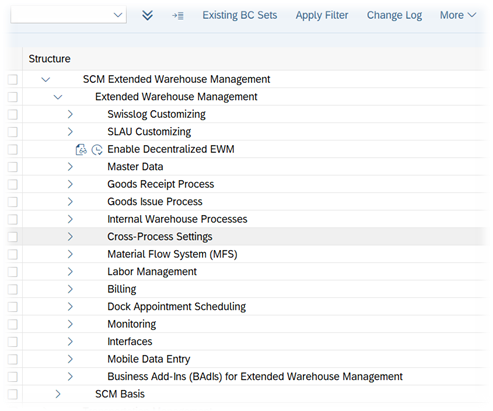
Another essential skill is – of course – to study EWM inside out. Understand its core components, processes, and functionalities. Start with SAP best practices, as they provide a solid foundation for your EWM knowledge. Build on this with project-specific explorations. Identify the EWM features and functionalities relevant to your projects and work packages. This way you study the theory (e.g., through books, blogs, or courses/trainings) alongside hands-on exploration of these features. This helps especially when you are not confident in understanding all aspects related to the process you are configuring.
3. ABAP
Part of the truth is also, that I have not seen a project yet that could be realized without any additional lines of code. While standard functionalities cover a lot, specific business requirements often necessitate additional enhancements.
As a consultant, close collaboration with developers during specification and testing phases is crucial. They bring your custom logic to life within SAP EWM. Having a basic understanding of programming is immensely helpful. When specifying enhancements, you can provide a high-level design, minimizing misunderstandings. By reviewing initial iterations of custom code, you reduce efforts spent on unnecessary test cases. Debugging during development testing is essential based on my experiences. It streamlines communication and ensures efficient issue resolution. You do not have to reach out to your developer right away for every scenario that fails; debugging helps you find bugs in the code and mistakes made during your tests.
Thus, I suggest familiarizing yourself with ABAP basics—at least the core concepts and commands. Recommended learning resources include books (there are many for ABAP beginners), basic courses (such as those on SAP Learning Hub or Udemy), and hands-on practice (e.g., try writing your own short and simple reports in your sandbox). Last but not least, play with the debugger! It's your ally in understanding code execution and your best buddy during troubleshooting and custom solution design. There are many good blogs and articles online providing basic information on how to use this tool.
As you gain proficiency and feel comfortable with the most-used commands and objects, try to find code corresponding to functions described in books and help texts. This is where it really becomes exciting (at least for the nerds 😉)! I promise you'll uncover some hidden gems—features and details not found in standard EWM literature. Sometimes, the real magic (SAP's best-kept secrets) lies beyond the documented pages. 😉
4. End-to-end SAP processes (incl. ERP)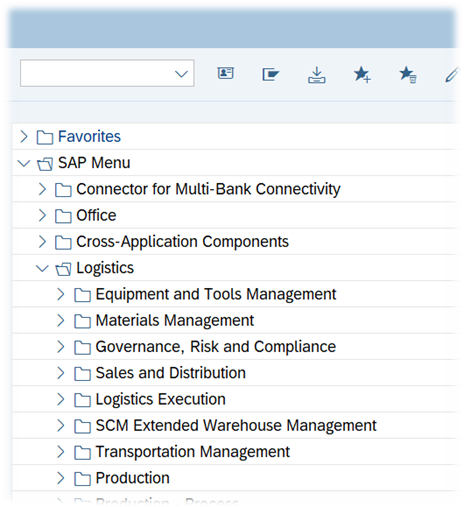
You can run EWM as a standalone system without integrating it into any ERP system. However, in over 95% of the projects I've been involved in, EWM was connected to a SAP ERP system in some way or another.
Without knowledge of the ERP modules, delivering comprehensive solutions or processes within EWM can be challenging. While there are parts of EWM that may not directly impact or be affected by ERP modules, limiting yourself to those areas restricts your scope.
Therefore, it's essential to understand the core functionality of certain ERP modules:
- Materials Management (MM): Familiarize yourself with MM processes, including procurement and inventory management. Also study how MM triggers the creation of inbound deliveries via SAP LES (Logistics Execution System).
- Sales and Distribution (SD): Understand SD processes related to sales orders, and distribution. Also study how SD triggers the creation of outbound deliveries via SAP LES (Logistics Execution System).
- Production Planning (PP): Although not the top priority, having knowledge of PP can be beneficial. Try to understand the different approaches available to integrate EWM with PP.
- Quality Management (QM): Consider QM as a nice-to-have skill. I used to go for an opportunistic approach here and study what I need when I encounter projects that require it.
- Transportation Management (TM): While helpful, TM expertise is often readily available when integrating EWM with TM. My personal opinion is that an EWM consultant should rather focus on the core ERP modules than spending a lot of time building TM knowledge (whereas I am aware that this might be a controversial point).
In summary, grasp the essentials of MM and SD, and consider expanding your knowledge to PP and QM as needed. TM, while useful, takes a backseat compared to the critical ERP modules as you will usually be surrounded by TM experts when the latter is in scope of your projects.
5. Capture process details & Draw processes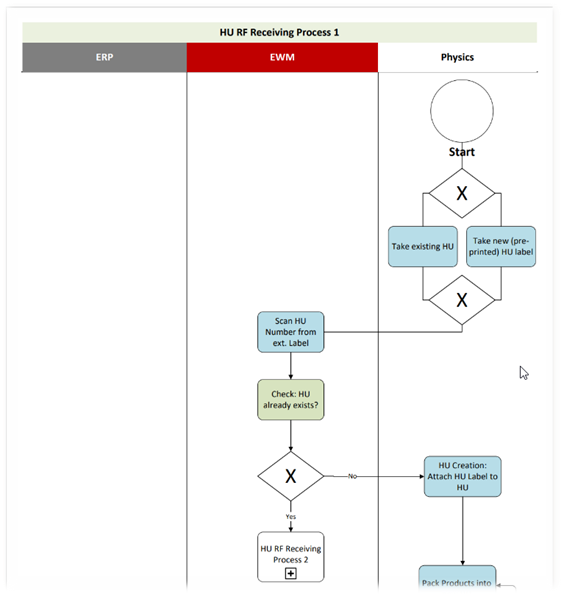
In the end, working with EWM is all about processes. The process is at the center, and everything else develops around it.
Define an approach that works for you to capture process-related details in a structured way. Excel or OneNote are great options, but other mind-mapping tools can be just as effective if you feel comfortable and efficient using them.
Additionally, learn a simple notation for drawing processes (e.g., a basic version of UML or BPMN). The specific notation you follow doesn't matter as much as consistency in your flow charts (shapes, colors, etc.) and speed in applying it. Drawing processes should become routine; you shouldn't have to think about which shape to use while drawing a flow. Practice until you know by heart which elements to use. If it doesn't become routine, it will slow down your workflow. Once it does, you will greatly benefit!
This skill will help you communicate with business teams on one side and development teams on the other. It will also assist you with all functional tasks related to the given process.
I am mostly using MS Visio. If you do not have access to the office suite, I recommend draw.io, a free diagramming tool (browser-based or desktop app) that allows you to create and share diagrams without requiring login or registration.
With these five skills or characteristics, I am closing the first part of this blog post. These were the technical and functional ones that build what I call the "foundation." Stay tuned for the second part of the post, which I will release in couple of weeks. It will cover the skills you add on top of your technical and functional foundation to fine-tune your profile!
📧 Newsletter
Get updates about new blog posts directly in your inbox.
▶️ YouTube Channel
Subscribe to my channel for regular tutorials & insights about SAP EWM.